
Last Updated: July 2026
Choosing the right mutual fund is one of the most important financial decisions an investor can make. With thousands of mutual fund schemes available in India, selecting the most suitable one can feel overwhelming, especially for beginners.
Many investors make the mistake of choosing a fund solely based on recent returns or recommendations from friends and relatives. However, the best mutual fund for one person may not be the right choice for another. Every investor has unique financial goals, a different investment horizon, and a different ability to tolerate risk.
A well-chosen mutual fund should match your personal financial objectives rather than simply offering the highest historical returns. Whether your goal is wealth creation, retirement planning, your child’s education, or saving for a major purchase, selecting the appropriate fund category is essential for long-term success.
In this comprehensive guide, you’ll learn the key factors to consider before investing, understand how to evaluate mutual funds, and discover practical tips to help you make informed investment decisions.
Author’s Note
I am Suresh Vankar, a finance professional with more than 15 years of experience in banking, lending, insurance, and personal finance.
Throughout my career, I have interacted with many first-time investors who believed that selecting the highest-returning mutual fund was the secret to successful investing. In reality, successful investing is about choosing a fund that aligns with your financial goals, risk tolerance, and investment horizon.
Through SV Finance, my mission is to simplify financial concepts and help Indian investors make informed decisions with confidence. This article is based on educational research, publicly available information, and practical investing principles. It is intended for educational purposes only and should not be considered personalized investment advice.
Why Choosing the Right Mutual Fund Matters
A mutual fund is not just an investment product—it is a financial tool that should support your long-term goals.
Selecting the wrong mutual fund may result in:
- Taking unnecessary investment risk.
- Lower-than-expected returns.
- Emotional decisions during market volatility.
- Difficulty achieving financial goals.
On the other hand, selecting the right mutual fund can help you:
- Build long-term wealth.
- Stay invested during market fluctuations.
- Achieve financial goals systematically.
- Benefit from disciplined SIP investing.
- Reduce unnecessary investment stress.
The right fund is the one that you can confidently remain invested in for many years.
What You Will Learn
- Why financial goals should come before fund selection.
- How to assess your risk appetite.
- Different types of mutual funds.
- Important factors to compare before investing.
- Common mistakes investors should avoid.
- Practical tips for beginners.
- Frequently Asked Questions.
- Expert recommendations from Suresh Vankar.
Table of Contents
Step 1: Define Your Financial Goal
The first step in choosing a mutual fund is identifying why you are investing.
Ask yourself:
- Are you investing for retirement?
- Are you saving for your child’s education?
- Do you want to build long-term wealth?
- Are you planning to buy a house?
- Are you creating an emergency fund?
Your financial goal determines the type of mutual fund that may be suitable for you.
For example:
- Short-term goals may be better suited to lower-risk debt-oriented funds.
- Long-term wealth creation often involves equity-oriented mutual funds.
- Medium-term goals may benefit from hybrid funds that balance growth and stability.
Defining your objective before investing helps you select a mutual fund that supports your financial journey instead of simply following market trends.
Step 2: Understand Your Risk Appetite
Once you have defined your financial goal, the next step is understanding your risk appetite.
Risk appetite refers to your ability and willingness to handle fluctuations in the value of your investments.
Every investor is different.
Some investors remain calm even when markets decline significantly, while others become anxious after small market corrections.
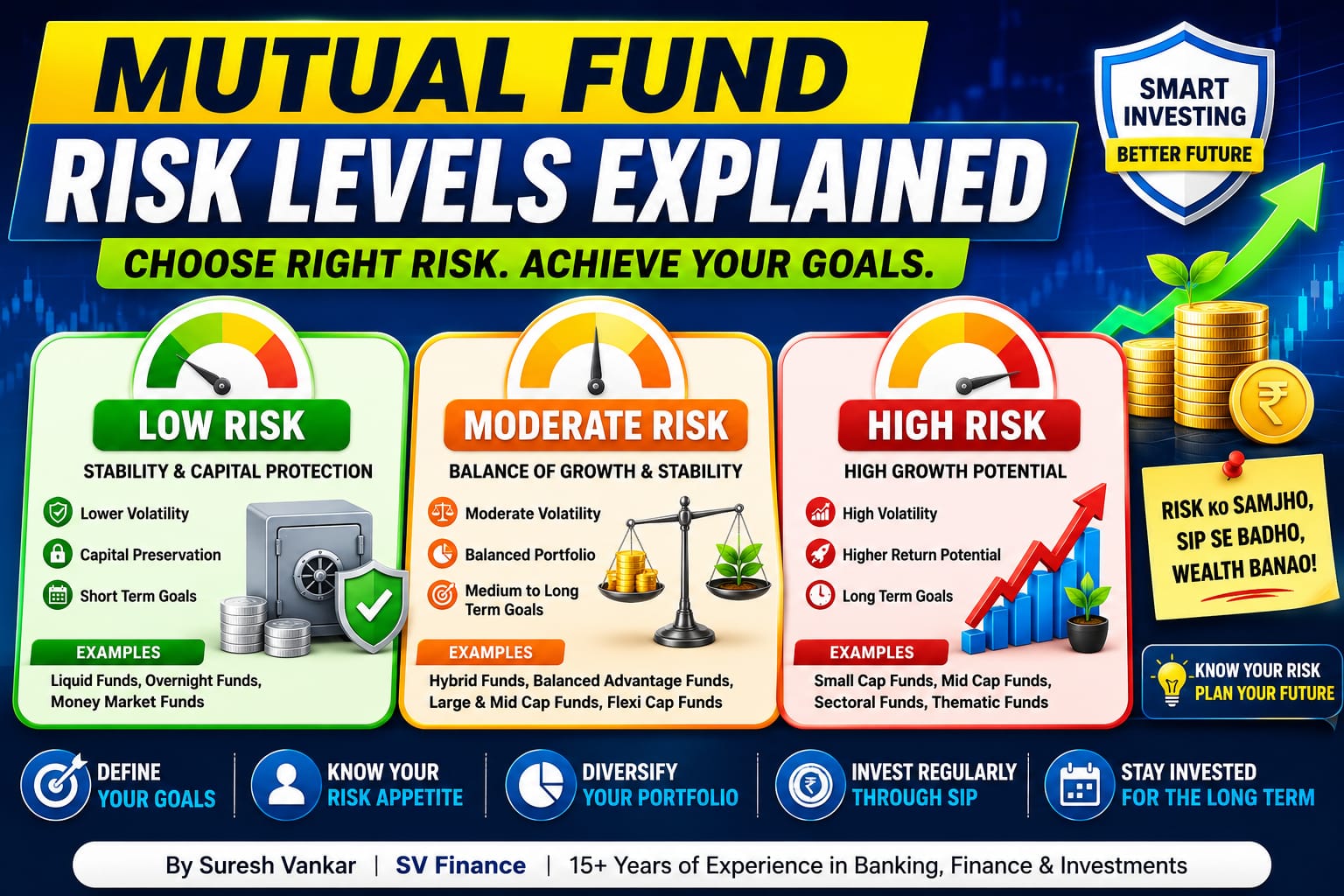
Generally, investors fall into three categories:
Conservative Investors
Suitable for investors who:
- Prefer stability over high returns.
- Want lower investment risk.
- Are investing for short-term goals.
These investors may consider Debt Mutual Funds or Conservative Hybrid Funds.
Moderate Investors
Suitable for investors who:
- Want balanced growth.
- Can tolerate moderate market fluctuations.
- Have medium to long-term financial goals.
Hybrid Funds, Flexi Cap Funds and Large & Mid Cap Funds may be suitable options.
Aggressive Investors
Suitable for investors who:
- Have a long investment horizon.
- Can tolerate significant market volatility.
- Aim for long-term wealth creation.
Large Cap, Mid Cap and Small Cap Equity Mutual Funds are commonly considered by aggressive investors depending on their investment strategy.
Step 3: Choose the Right Mutual Fund Category
Selecting the correct mutual fund category is more important than selecting the “best-performing” fund.
Below are some common mutual fund categories.
Large Cap Mutual Funds
Suitable for:
- Beginners
- Long-term investors
- Moderate risk investors
Advantages:
- Invest in established companies.
- Lower volatility compared to Mid Cap and Small Cap Funds.
- Suitable for disciplined SIP investing.
Index Funds
Index Funds track market indices such as the Nifty 50 or Sensex.
Suitable for:
- Beginners
- Passive investors
- Long-term wealth creation
Advantages:
- Lower expense ratio.
- Broad market diversification.
- Simple investment strategy.
Flexi Cap Mutual Funds
Flexi Cap Funds invest across companies of different market capitalizations.
Suitable for:
- Investors seeking diversification.
- Long-term investors.
- Moderate risk appetite.
Advantages:
- Flexible investment strategy.
- Diversified portfolio.
- Professional fund management.
Mid Cap Mutual Funds
Suitable for:
- Investors seeking higher growth.
- Long investment horizon.
- Moderate to high risk appetite.
Advantages:
- Higher growth potential.
- Opportunity to invest in expanding businesses.
Small Cap Mutual Funds
Suitable for:
- Experienced investors.
- Long-term wealth creation.
- High risk tolerance.
Advantages:
- Highest growth potential.
- Opportunity to benefit from emerging companies.
However, Small Cap Funds also experience higher market volatility.
Step 4: Evaluate Mutual Fund Performance
Do not select a mutual fund simply because it delivered the highest returns during the previous year.
Instead, evaluate:
- Performance over 3, 5 and 10 years.
- Consistency across different market cycles.
- Investment philosophy.
- Fund manager’s experience.
- Portfolio quality.
Consistency is generally more valuable than short-term outperformance.
Step 5: Compare Expense Ratio
The Expense Ratio represents the annual fee charged by the fund house for managing your investment.
A lower expense ratio allows more of your investment to remain invested, which may positively influence long-term returns.
However, expense ratio should never be the only deciding factor.
Always evaluate it together with:
- Fund performance.
- Investment objective.
- Risk level.
- Portfolio quality.
My Professional Analysis
After working in banking and financial services for more than 15 years, I have observed that investors often spend too much time searching for the “best mutual fund.”
In reality, there is no single mutual fund that is best for everyone.
The right mutual fund depends on your financial goals, investment horizon, risk tolerance and commitment to long-term investing.
Rather than chasing recent returns, focus on building a disciplined investment habit through regular SIPs and periodic portfolio reviews.
In the next section, we’ll discuss common mistakes investors should avoid, answer frequently asked questions, and summarize the key principles for choosing the right mutual fund.
Common Mistakes Investors Should Avoid
Even after selecting a suitable mutual fund, many investors make mistakes that affect their long-term wealth creation.
Avoid these common errors.
1. Chasing Recent Returns
One of the biggest mistakes is investing in a mutual fund simply because it delivered exceptional returns in the previous year.
Past performance should not be the only reason to invest.
Instead, consider:
- Investment objective.
- Risk level.
- Consistency of performance.
- Fund manager’s track record.
- Expense ratio.
2. Ignoring Your Investment Horizon
Different mutual funds are designed for different investment periods.
For example:
- Short-term goals may be suitable for Debt Mutual Funds.
- Medium-term goals may suit Hybrid Funds.
- Long-term wealth creation generally favors Equity Mutual Funds.
Always match your investment horizon with the fund category.
3. Investing in Too Many Mutual Funds
Many beginners believe that investing in several mutual funds automatically provides better diversification.
In reality, owning too many similar funds can lead to portfolio overlap and make it difficult to monitor your investments.
A well-planned portfolio with a limited number of suitable funds is often more effective.
4. Ignoring Portfolio Reviews
Your financial goals and market conditions may change over time.
Review your mutual fund portfolio at least once a year to ensure it continues to align with your objectives.
However, avoid making investment decisions based on short-term market movements.
5. Stopping SIP During Market Corrections
Market volatility is a normal part of investing.
Many investors stop their SIPs when markets decline.
In reality, continuing SIP investments during market corrections allows you to accumulate more units through Rupee Cost Averaging, which can benefit long-term wealth creation.
Expert Tips for Choosing the Right Mutual Fund
Based on my experience in banking and financial services, here are a few practical recommendations.
- Define your financial goal before investing.
- Understand your own risk tolerance.
- Choose the appropriate mutual fund category.
- Compare long-term performance rather than recent returns.
- Consider the expense ratio.
- Invest regularly through SIP.
- Review your portfolio once every year.
- Stay invested for the long term.
Successful investing is built on discipline, patience, and consistency—not on predicting short-term market movements.
Frequently Asked Questions
1. How do I choose the best mutual fund?
Start by identifying your financial goal, investment horizon, and risk appetite. Then compare mutual funds based on their category, long-term performance, expense ratio, and consistency.
2. Which mutual fund is best for beginners?
Many beginners prefer diversified options such as Index Funds, Large Cap Funds, or Flexi Cap Funds because they provide broad market exposure and are suitable for long-term investing.
3. Should I invest based on past returns?
No.
Past performance can provide useful information but should never be the only deciding factor. Always evaluate the fund’s investment strategy and suitability for your financial goals.
4. How often should I review my mutual fund portfolio?
A yearly review is generally sufficient for most long-term investors unless there is a major change in your financial goals or personal circumstances.
5. Can I invest in more than one mutual fund?
Yes.
Many investors build diversified portfolios by investing in different mutual fund categories according to their financial goals and risk tolerance.
Key Takeaways
- Define your financial goal before choosing a mutual fund.
- Understand your risk appetite.
- Select the appropriate mutual fund category.
- Compare long-term performance instead of short-term returns.
- Consider the expense ratio.
- Invest consistently through SIP.
- Review your portfolio periodically.
- Stay focused on long-term wealth creation.
My Final Thoughts
After spending more than 15 years in banking, lending, insurance, and financial services, I have realized that successful investing is not about discovering a “perfect” mutual fund.
It is about selecting investments that match your financial goals and staying committed to your investment plan.
Many investors delay investing because they fear making the wrong decision.
In my opinion, starting early with a well-researched mutual fund and investing consistently is usually more beneficial than waiting endlessly for the perfect opportunity.
Long-term wealth is created through patience, discipline, and regular investing—not by chasing the latest market trend.
Conclusion
Choosing the right mutual fund becomes much easier when you first understand your financial goals, investment horizon, and risk appetite.
Rather than searching for the highest-returning fund, focus on selecting a scheme that aligns with your personal financial plan and allows you to remain invested with confidence.
A disciplined SIP, periodic portfolio reviews, and a long-term perspective can help you build wealth steadily over time.
Remember, the best mutual fund is the one that helps you achieve your financial goals—not the one that simply delivered the highest recent returns.
Official Resources
Association of Mutual Funds in India (AMFI)
https://www.amfiindia.com
Securities and Exchange Board of India (SEBI)
https://www.sebi.gov.in
SEBI Investor Education
https://investor.sebi.gov.in
Also Read
- Best SIP Mutual Funds for Beginners 2026
- Large Cap vs Mid Cap vs Small Cap Mutual Funds
- Index Fund vs Active Mutual Fund
- Mutual Fund Risk Levels Explained
- SIP vs Lump Sum: Which Investment Strategy Is Better?
About the Author
Suresh Vankar is a finance professional with more than 15 years of experience in banking, lending, insurance, and personal finance. Through SV Finance, he publishes practical, research-based articles that simplify mutual funds, banking, taxation, insurance, and financial planning to help Indian readers make informed financial decisions.
Disclaimer
Mutual fund investments are subject to market risks. Read all scheme-related documents carefully before investing. This article is intended for educational purposes only and should not be considered investment advice or a recommendation to invest in any specific mutual fund scheme. Investors should assess their financial goals, risk tolerance, and consult a SEBI-registered investment adviser before making investment decisions.